Who Actually Maintains Trino's Connectors?
Two years of commits to every documented Trino connector, with fleet-wide housekeeping separated from real attention: the lakehouse three absorb half of it, the median connector gets less than one specific commit a month, and two people write a third of all of it.
John Kinson 4 min read
Federation’s promise is the catalog page: Trino documents 36 connectors, one SQL dialect over all of them. The commit log tells you which parts of that promise anyone is actually keeping. I pulled every commit from the last 24 months touching each documented connector’s plugin directory in the public Trino repository, then separated fleet-wide housekeeping from connector-specific work.
Findings
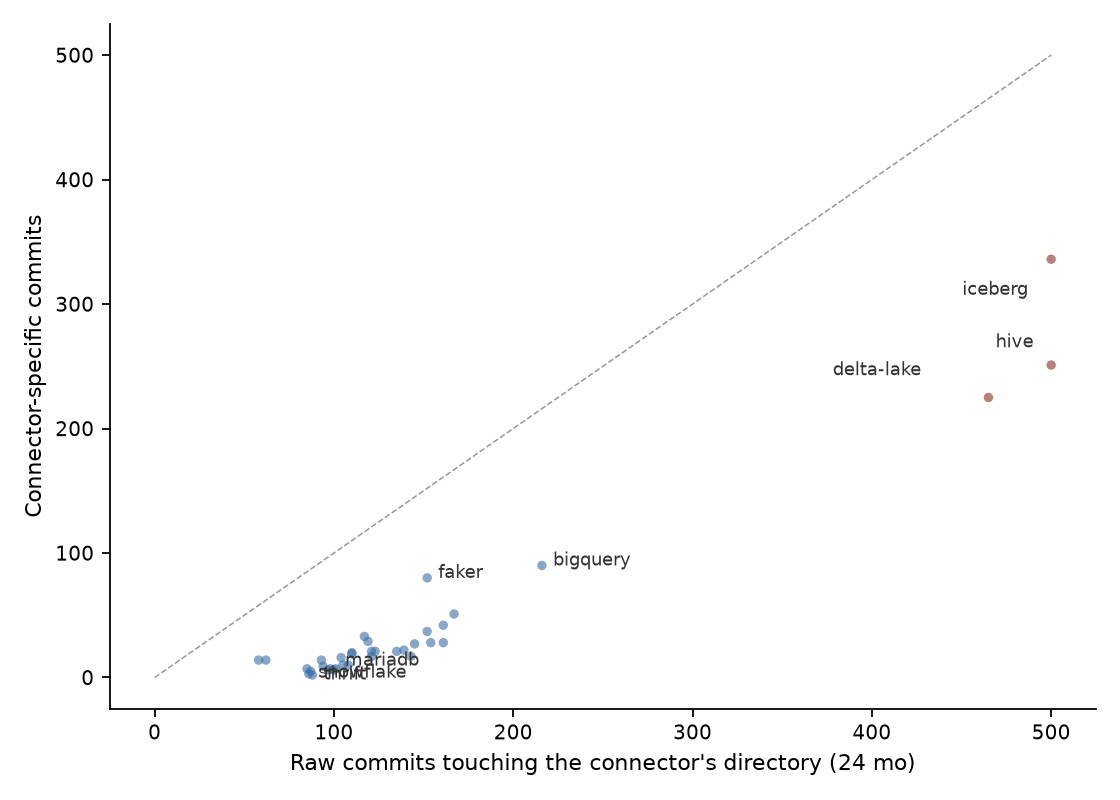
- 60% of naive per-connector “activity” is housekeeping, not attention. 172 commits each touched five or more connector directories at once — dependency bumps, refactors, test-infrastructure changes rippling across the fleet. Count commits per directory and every connector looks maintained; a dormant connector inherits ~80 commits a year just by existing in the tree. Any dashboard that measures connector health by raw directory activity is mostly measuring this.
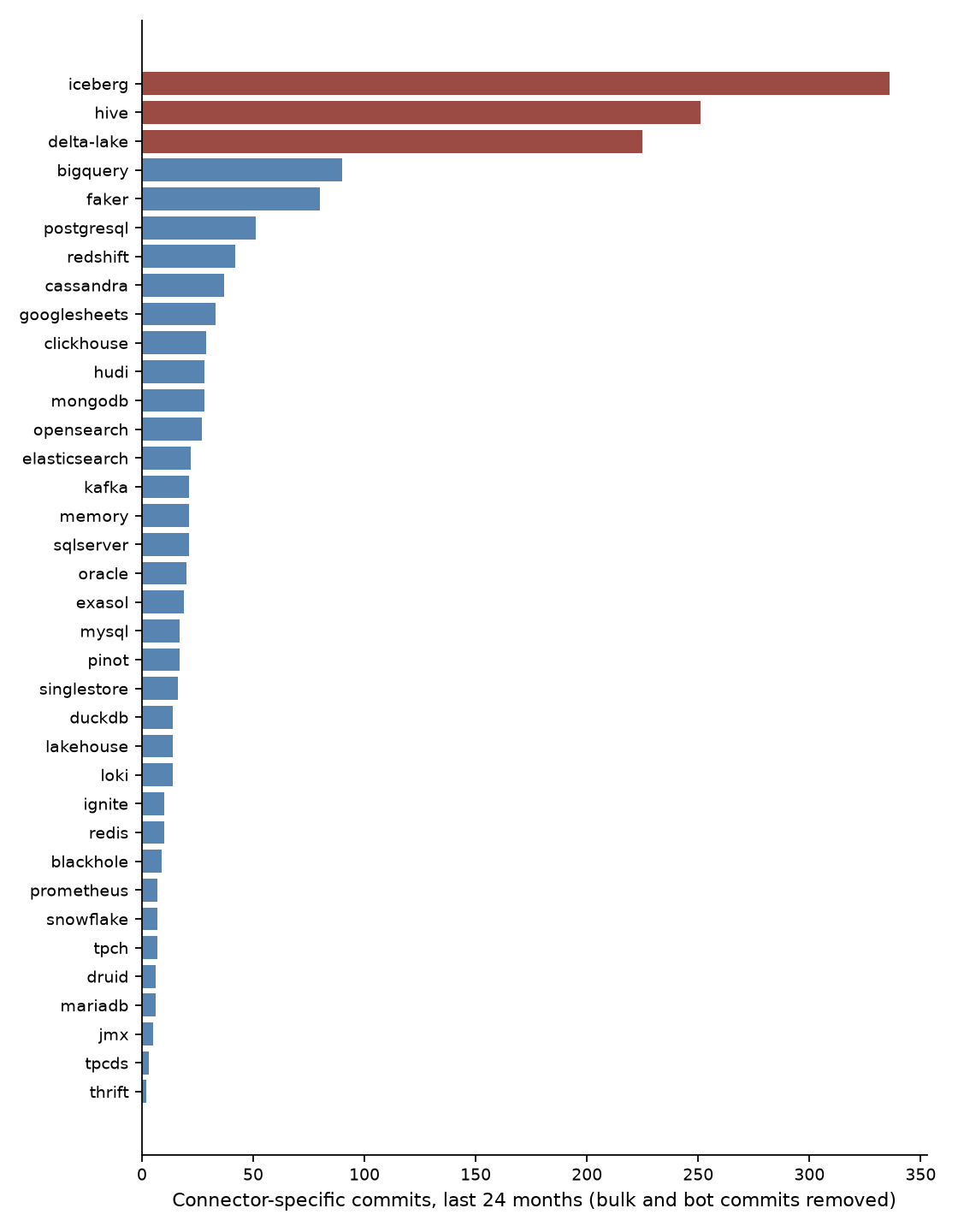
- Real attention is a lakehouse story. After removing fleet commits and bots, 1,545 connector-specific commits remain. Iceberg, Hive, and Delta Lake take 53% of them; add BigQuery and the test-data generator Faker and five directories take 64%. The bottom half of the catalog — eighteen connectors — shares 12%.
- The median connector gets less than one specific commit a month. Median: 19.5 over two years. Twenty-three of 36 connectors sit below one per month; eleven below one every other month. The far tail over the full two years: Thrift 2, TPC-DS 3, JMX 5, MariaDB 6, Druid 6, Snowflake 7.
- Two people write a third of it. 119 humans made connector-specific commits; the top two account for 36% of all of them. On tail connectors the pattern sharpens: typically two to four authors, with the busiest writing 40–70% of that connector’s changes.
- Alive is not the same as advancing. The fleet commits are genuinely valuable — every connector compiles, passes tests, and tracks current dependencies because maintenance is socialized. What is concentrated is everything else: features, bug fixes, performance work. The catalog is kept airworthy centrally and flown only where the traffic is.
What this means if you run federation
Read the catalog as three tiers, not one. The lakehouse core is where the project’s gravity is — betting on it means moving with the current. The JDBC middle (PostgreSQL, SQL Server, Oracle, MySQL and kin) is mature and quietly tended, and lower change volume there partly reflects that the JDBC abstraction concentrates shared work in a common layer. The tail is where the operational question lives: if your critical path runs through a connector getting six specific commits in two years from three people, you are not buying a supported integration — you are inheriting a codebase with excellent CI. Sometimes that’s fine. It should just be a decision, not a surprise: before an SLA depends on a connector, look up its specific-commit rate and author count. It takes five minutes and predicts your support experience better than the documentation page does.
Method, briefly
All 36 connectors documented in the Trino repo, mapped to their plugin/ directories. Every commit touching each directory over the trailing 24 months via the GitHub API (Iceberg and Hive hit the 500-commit collection cap, so their totals are understated). Commits deduplicated by SHA across connectors: a commit touching five or more connector directories is classed as fleet housekeeping; “connector-specific” means it touched exactly one, with bot authors removed. Commits touching two to four directories (~10% of the unique total) sit in neither bucket.
Caveats
- Commits measure attention, not quality. A mature connector legitimately needs fewer changes; low volume plus low author count is the risk signal, not low volume alone.
- The public repo is not the whole economy — vendors maintain private forks and paid support layers this analysis cannot see.
- Work outside
plugin/(docs, shared JDBC infrastructure, the engine itself) isn’t attributed to connectors, which understates the middle tier. - One 24-month window; a connector’s story can turn in a quarter.
The catalog page answers “can Trino talk to it?” The commit log answers the question that determines your on-call load: “when it breaks, who is coming?” For three connectors the answer is “dozens of people, this week.” For most of the catalog, it’s worth checking before you find out.